
JDG: we rather collapse than expand
Times are changing, the debate over health insurance premiums has been raging for over 20 months, and the statistics remain weak. In the first half of this year, trends in sole proprietorships (SMEs) remained unchanged. The data are even worse than in recent years. SMEs continue to shrink rather than expand.
In the first half of 2025, 146,975 new businesses were registered in Poland, and 99,369 were reopened. However, as many as 176,231 self-employed entities were suspended, and 98,218 were closed. Therefore, closed and suspended businesses still outnumber new and reopened businesses (274,449 vs. 246,344).
The second quarter of this year was, as usual, better than the first. This is due to seasonality – in the spring, businesses open and resume tourism-related businesses. In April, May, and June, coastal municipalities are usually among the leading economically “recovering” communities.
After June, the quarterly InfoCredit index rose to -374 points from -27,731 points after the first quarter of 2025 (when its value is above 0, it means that more businesses were opened and reopened than suspended and closed). The problem is that last year at this time, the index was worth +1,440 points. The situation is getting worse year by year.
In the first quarter of this year, the data were also worse than in the same period of 2024. 118,822 self-employed units (UDGs) were reopened and established, and 146,553 were closed and established, compared to 120,599 and 147,418 a year earlier. The quarterly calculated IC index was therefore worth -27,731 points (after Q1 2024, it was -26,819 points).
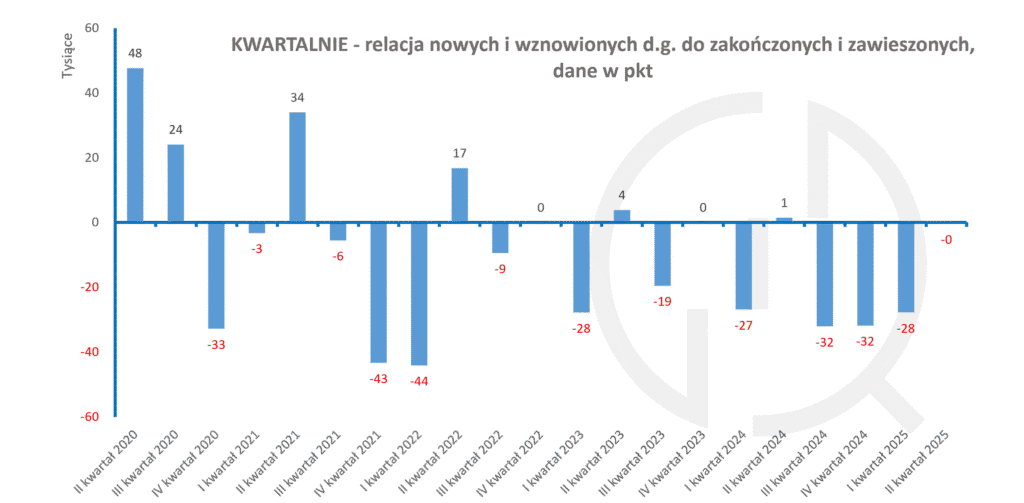
The reasons remain the same – rising business costs, regulatory uncertainty, and the decline in the profitability of small businesses. Given the current labor market, full-time employment is becoming more attractive than self-employment. Furthermore, in May, the chance for relief for entrepreneurs was blocked – the president vetoed the bill lowering health insurance contributions. For many sole proprietors, this signals that real changes are unlikely for now. This is especially true given that there was no consensus on a contribution reduction, even at dinner.
The disturbing trend is even more evident in the monthly InfoCredit index. After a slight recovery in March, April, and May, the index declined again in June. At the end of June 2025, it stood at -6,911 points, compared to -5,433 points a year earlier.
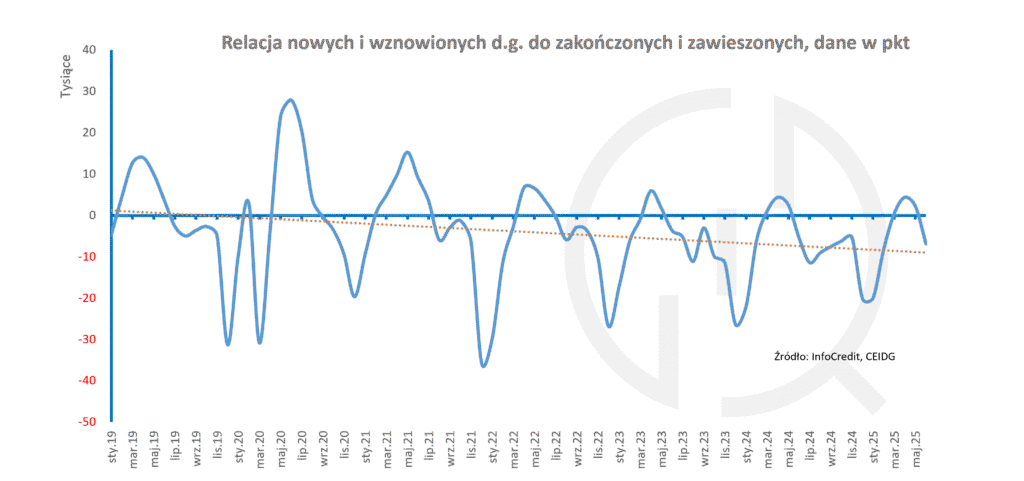
“The data clearly shows that, unfortunately, the high number of business suspensions and closures continues. Significantly, significant increases in this area occurred not in 2020 or 2021, when we were faced with restrictions resulting from the pandemic, but later – essentially from 2022, i.e., during the era of new tax rules established by the infamous Polish Deal and during a period of – at least temporarily – very high inflation,” says Jakub Bińkowski, board member of the Association of Entrepreneurs and Employers.
According to Jakub Bińkowski, the deteriorating condition of the smallest businesses is caused by growing cost pressure – generated by increases in contributions (health insurance contributions after the Polish Deal, the permanent mechanism for indexing ZUS contributions), as well as the rising costs of both semi-finished products, products, and raw materials used to run the business, as well as employment (dynamic wage growth, further stimulated by the rapidly rising minimum wage until 2024). In this context, the presidential veto of the government’s proposed reduction in healthcare contributions for businesses was indeed disappointing.
“Entrepreneurs are not responsible for the underfunding of the healthcare system – it seems this was forgotten when deciding on the fate of that bill,” summarizes a board member of the Union of Entrepreneurs and Employers.
How We Calculate the InfoCredit Business Activity Index
Our business activity index shows the ratio of new and reopened businesses to closed and suspended businesses. When the index is positive, it means that more businesses were started and reopened than were suspended and closed. The higher the index value, the greater the propensity to open small businesses. When the index shows values below zero, it indicates a retreat from this form of economic activity. The further the index falls, the more small businesses are going out of business (permanently or temporarily). We publish the index quarterly (after each quarter) and monthly. For individual municipalities, the index value is calculated per 1,000 inhabitants.