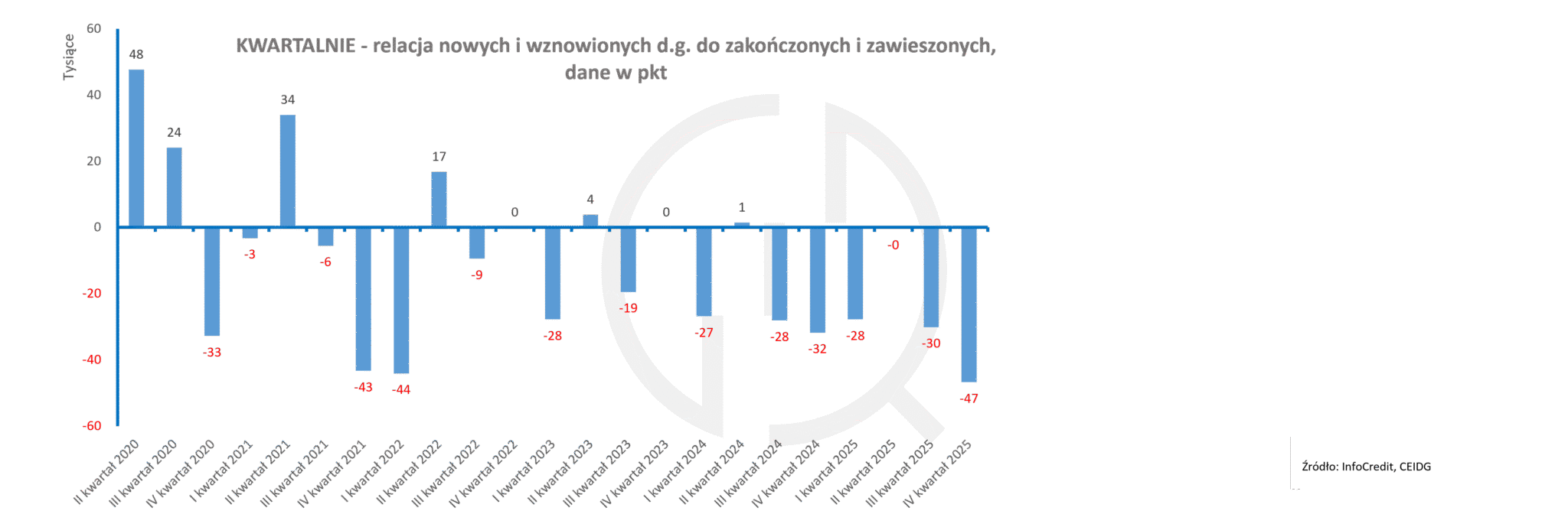
The largest outflow from JDG in history
InfoCredit Microentrepreneurship Index
- Nearly 388,000 sole proprietorships (SMEs) were suspended in 2025. Another record of weakness was set – the fourth in a row. In 2024, we recorded 375,700 suspensions. 196,700 SMEs were closed, with only 2023 seeing a worse situation.
- At the end of last year, the negative trend accelerated. Even after November, it seemed that further records would not be broken.
- The InfoCredit Business Activity Index fell to -46.76 thousand points quarterly after December, a level never seen before. Monthly, the index is seeking a bottom, meaning it’s close to the levels seen when the pandemic broke out or when the full-scale war in Ukraine began.
- This means that the basic form of entrepreneurship in Poland, i.e. self-employed individuals, is experiencing the greatest crisis in its history.
The end of last year saw a significant shift away from self-employed workers (JDG). In the last three days of December alone, nearly 15,000 businesses were suspended, and nearly 10,500 were closed. For comparison, 2,933 new JDGs were registered during that time. Throughout December, 64,600 businesses were suspended and closed, while 33,700 were opened and reopened. This hasn’t happened yet, resulting in further lows in the JDG InfoCredit index.
What happened at the end of last year is certainly related to the confusion that accompanied attempts to regulate the labor market. As a reminder, at the beginning of December, the prevailing message was that officials from the National Labor Inspectorate would be able to administratively reclassify a B2B or civil law contract as a full-time job if the actual method of service provision was consistent with an employment relationship. These powers were gradually limited. Initially, such decisions were to be enforced immediately. Later, this procedure was relaxed, giving the parties room to adjust their cooperation model. In any case, until the end of last year, the message was clear: apparent self-employment, meaning, for example, one self-employed person (JDG) for one client, was risky. This could have influenced the decisions of those working in this mode. The market reacted not to the final shape of the regulations, but to the uncertainty and lack of a clear direction for change.
The new year brought a turnaround. The draft bill amending the Act on the National Labor Inspectorate and certain other acts, adopted on December 4th by the Standing Committee of the Council of Ministers, was met with strong criticism from the Prime Minister. He believed that officials were gaining too much power. On January 28th, Money.pl obtained details of the new proposal, developed by the Ministry of Family, Labor and Social Policy and the Ministry of Justice. The inspector will still be able to issue an administrative decision to transform disputed contracts, but it will be immediately appealable to the court (instead of first to the Chief Labor Inspector). In such a case, its execution will be suspended until a final ruling is issued. This is only the beginning of the legislative process, but both ministries are pressing for time. The provisions strengthening the role of the National Labor Inspectorate are one of the milestones of the National Labor Inspectorate (KPO). This means there isn’t much time to work on them. Employers will be pressured to restructure contentious B2B contracts, and the junk contracts will remain.
The situation on the labor market further complicates matters. Unemployment rose to 5.7% in December 2025 (5.1% the year before). Year-on-year, the number of registered unemployed increased by 101,700. The dynamics of new registrations are also increasingly alarming – 93,600 people were granted unemployment status in December, which, given the persistently high level of layoffs, demonstrates a steady influx of job seekers.
2025 also proved to be a record year for collective layoffs – over 97,600 were reported to labor offices, the highest number since the global financial crisis of 2008–2009 and almost three times as many as in 2024. At the same time, there is a stark disproportion between the number of suspended and terminated self-employed workers in December 2025 and the number of new and reopened businesses (64,600 vs. 33,700). This has not yet translated directly into unemployment statistics – most people leaving self-employed workers have alternative sources of income or other career plans. However, the scale of these movements demonstrates a profound realignment in the labor market and entrepreneurship.
On the other hand, the market is operating under growing regulatory and social pressure related to attempts to “civilize” forms of employment and limit bogus self-employment. This is changing the calculations for both employees and employers. What does this mean for the self-employed worker market in the coming quarters?
InfoCredit Forecasts
1. The outflow of “full-time” self-employment will slow, but not stop.
The government’s withdrawal from the administrative transformation of contracts by the National Labor Inspectorate (PIP) reduces regulatory pressure but does not address the main problem: uncertainty. Some people will remain with self-employed individuals (DDs), but a business model that effectively resembles a full-time position will gradually lose its raison d’être.
2. The DDs market will undergo another year of selection.
After a record-breaking 2025, the pace of business closures and suspensions may slow, but the overall number of DDs will remain under pressure. Companies established primarily for cost reasons will disappear from the market, while businesses with a viable business model have a chance to survive.
3. The structure of DDs will change faster than their number.
The share of design and specialist companies (IT, consulting, engineering, creative) will increase, while self-employment in simple, subordinated roles that are easily replaced by employment or automation will decrease.
4. The “one sole proprietorship – one client” model will remain an area of increased risk.
Even with a relaxation of legislative announcements, regulatory uncertainty and regulatory practices will reward effective business independence. Entrepreneurs will be more likely to build client portfolios or change the scope of their cooperation.
5. The InfoCredit JDG Index will remain negative, but the scale of declines may diminish.
After a historically weak 2025, stabilization at low levels is possible, not a rapid rebound. Without systemic relief or cost simplifications, JDGs will remain sensitive to fluctuations in demand, fixed costs, and the labor market situation.
How We Calculate the InfoCredit Business Activity Index
Our business activity index shows the ratio of new and reopened businesses to closed and suspended businesses. A positive index means that more businesses were started and reopened than were suspended and closed. The higher the index value, the greater the propensity to open small businesses. A negative index value indicates a retreat from this form of economic activity. The further the index falls, the more small businesses exit (permanently or temporarily). We publish the index quarterly (after each quarter) and monthly. In the case of individual municipalities, the index value is calculated per 1,000 inhabitants.