


What is it like at the Polish seaside?
Did you know that…
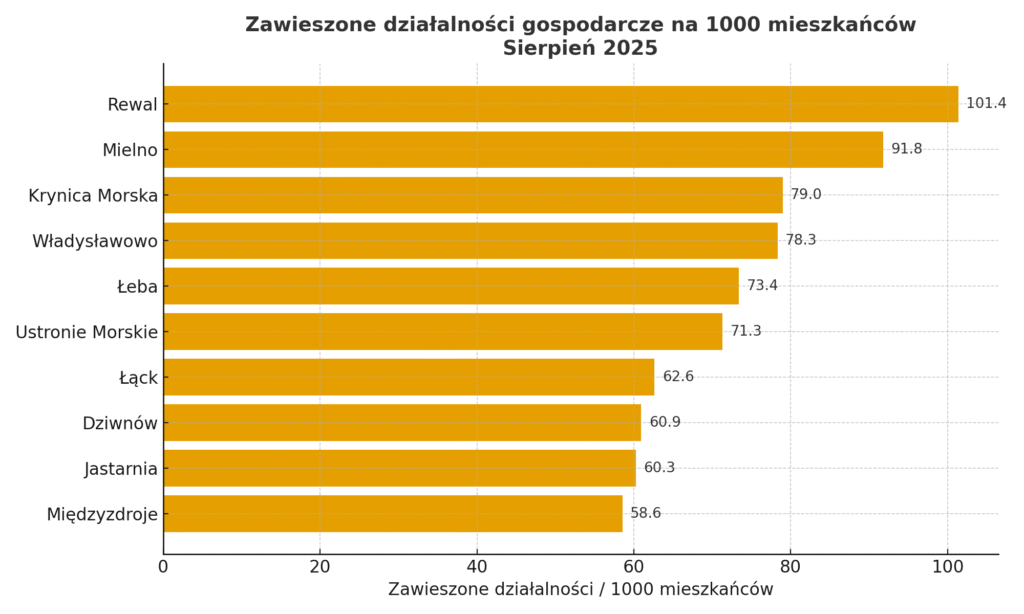
Rewal is a Polish municipality that experiences the fastest economic recovery in spring, only to fall asleep the fastest at the end of the summer holidays. The data on sole proprietorships (SMEs) is accurate.
The 2025 summer season was highly unusual. The weather had a significant impact on seaside attendance and the tourism industry’s performance. However, a relatively warm September proved to be a boost for many entrepreneurs who decided not to suspend their businesses at the end of the summer holidays.
Rewal is one of the municipalities in Poland with the highest number of business closures per 1,000 residents in the spring. In this municipality, the InfoCredit index is approaching +50 points before the season, meaning that one SME for every 20 residents is suspended or reopened. In the fall, the reverse is true.
After August, the indices for typically tourist-oriented, coastal municipalities plummet, reaching values similar to those in spring, but in the red. For example, in Rewal, one SME for every 20 residents is suspended. But… the weather determines the final score.
Coastal municipalities have seen smaller declines after August this year than last year. Rewal remains the leader in the negative ranking, but its score improved from -45 points in 2024 to -35 points in 2025. Mielno remained practically at last year’s level (-29 points), while Władysławowo and Łeba saw a slight improvement. Only Krynica Morska recorded a decline, dropping from -13.7 points to -15.5 points.
New municipalities also appeared on the list – including Ustronie Morskie, Krokowa, Solina, and Jastarnia – but their declines are much smaller, ranging from -4 to -9 points. This signals that, from a broader perspective, local tourism economies did not experience as abrupt an “autumn slumber” as in 2024.
Why? This summer was unusual. July was cool and rainy, leading to a wave of cancellations and short-term vacations. September, however, turned out to be exceptionally warm and sunny. As a result, many tourists postponed their vacations. This shift in tourist flow meant that establishments and guesthouses didn’t close as abruptly at the end of August as they did the previous year.
The conclusions from this year’s data are clear: seasonality still determines the economy of tourist municipalities, but unusual weather conditions can significantly mitigate the scale of declines. This demonstrates how dependent local businesses are not only on the holiday calendar, but also on the weather and tourists’ willingness to plan their trips flexibly.
There are 2,477 municipalities in Poland. We monitor them all. Want to know what’s happening in your voivodeship, district, or municipality? Contact us: infocredit@infocredit.pl or media@infocredit.pl. We look forward to hearing from you.
How we calculate the InfoCredit Business Activity Index
Our business activity index shows the ratio of new and reopened businesses to closed and suspended businesses. A positive index means that more businesses were started and reopened than were suspended and closed. The higher the index value, the greater the propensity to open small businesses. A negative index value indicates a retreat from this form of economic activity. The further the index falls, the more small businesses are going out of business (permanently or temporarily). We publish the index quarterly (after each quarter) and monthly. For individual municipalities, the index value is calculated per 1,000 inhabitants.